The Blessing of Being Challenged
I just read a biography of Isaac Newton, who was born into the English Civil War and lived through the Plague in the 1660s. It’s no wonder he loved to study motion and change, because in his young life the world was in constant flux.
Undeniably his curiosity, creativity and unique intellect were the basis of his groundbreaking scientific work. But it’s the meticulous mathematical proofing of his theories, which he found himself compelled to do after older and more established scientists scoffed at his ideas, that make Newton’s laws the basis of our understanding of nature today.
Despite his genius, Newton was in his person not so very different from you or I. He did not appreciate his critics, and hated his rivals. When someone would publicly denounce one of his works as unproven and unfounded, his usual response was to despair and sulk for a while, a few weeks to several months at a time. Then he would work feverishly, driven by revenge on his challengers, to complete the mathematical proofs of what he had published. The results were not completely unassailable, but certainly ironclad, to the point where almost 400 years later they are still taught to schoolchildren worldwide.
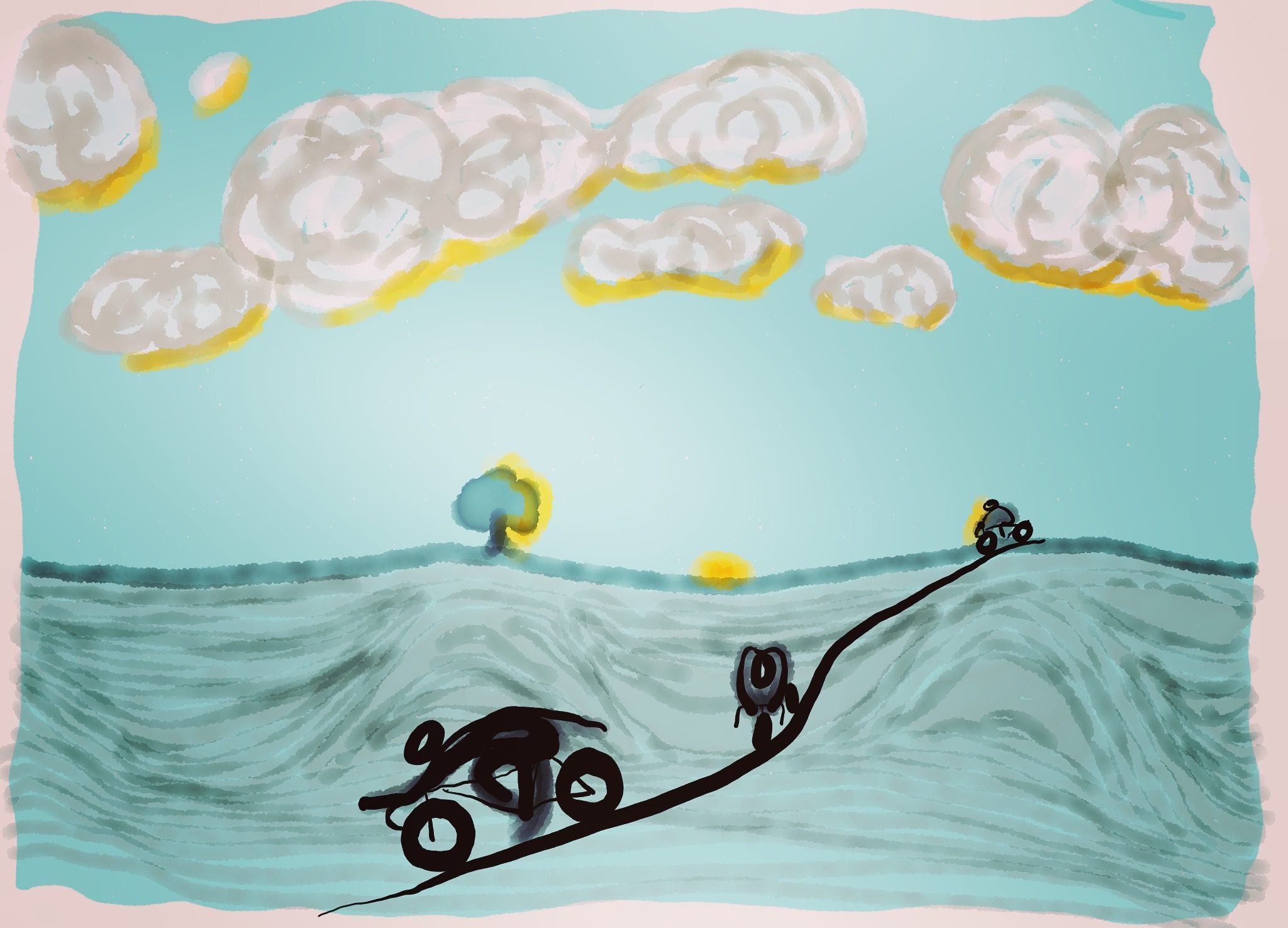
What would our modern body of scientific understanding look like today, had Newton not been pushed and embarrassed initially by his detractors? It’s hard to say, but it would certainly be different from what we know and what inspired Einstein, Hawking and others. In summary: Being challenged and lambasted sucks at the time, but it often provides the push we need to get ourselves from good to great. We should thank those who question our work and call out flaws in it, instead of letting them get to us personally.
Here endeth the lesson on being shoved.
 Bike Newbie