Different riding styles to match conditions–Part 3, Wind

More than hills, rain, rough road or anything else, wind can make a huge difference in what kind of ride you have.  If it’s at your back, you can enjoy high speeds with minimal effort.  When it’s in your face or at your side, it can make an ordinarily fun ride miserable, feeling like you’re grinding your life force away and making barely any forward progress.  The only way to eliminate wind effects entirely is to ride indoors, but there are some things you can do to at least partially mitigate these effects outdoors.

  1. Drop-handlebar riding (into the wind).  Drop bars (the curly handlebars often seen on road bikes) are great…I only use them by riding with my hands in the lower or drop position on two occasions, but on these occasions they are a godsend.  One such occasion is descending a steep hill, and the other is riding into the wind.  Riding with your hands in drop forces your head, shoulders and back to follow suit, thus lowering your profile and your wind resistance, making you more aerodynamic.  It isn’t terribly comfortable but it does help you maintain speed into a headwind.  Practice riding with your hands in drop position occasionally, so that when you have to do it it doesn’t feel so weird.
  2. Gear adjustments.  When you suddenly find yourself riding into the wind, often you’ll be pedaling with great difficulty, at a much slower cadence.  The opposite is true when suddenly you have the wind at your back (your cranks starting spinning wildly with little resistance).  Shift gears so that you’re maximizing your pedaling efficiency and not wearing yourself out needlessly.  I’ve been told that an optimum cadence is around 70-75 RPM.
  3. Sitting upright (wind-assisted).  On those occasions (it seems like they’re all too rare) when you have the wind at your back assisting you, make the most of it.  Expose as much of your back to that wind as possible so that you’re like a sail.  You can do this by moving your hands back closer to your body and using a more upright, broad-shouldered body posture.  Shift to a “higher” gear and maintain a good cadence.
  4. Riding in formation (into the wind).  A lot of riding groups and bicycle clubs ride in a peloton, which is basically a formation where each rider takes turns “breaking trail” or serving as the windbreak of the group.  You can also do this with only two or three riders, though.  Each rider can take turns at the front of the line…this gives the riders (who should be as close in line as possible to benefit from this) a break by cutting way down on the wind resistance they encounter.
  5. Dropping a shoulder (in crosswinds).  Crosswinds may not be as soul-crushing as headwinds, but they still can be difficult to ride in.  To give yourself extra stability in a heavy crosswind, lower your windward shoulder and ride just slightly “into the wind.”  It feels a little bit like pushing a tackling dummy with that windward shoulder.  When a big gust comes along, you’ll be a little more ready and a little less likely to be blown sideways.
  6. Managing expectations and attitudes.  Riding in a strong wind is never what I’d call fun, but there are ways you can make it manageable.  Recognize that there are some things you can’t control (the weather for example), and other things you can control such as your attitude.  Don’t be disappointed or angry if you’re “falling behind” your target pace because of unexpected wind.  Adjust your expectations to match the conditions and unforeseen changes.  Realize that everyone else on the ride is going through this, too.  Above all, be safe…if tree limbs or tops (or entire trees) are snapping out of the canopy due to the wind, you probably need to get off the road and into a safe place.

Different riding styles to match conditions–Part 2, Winter

If you live in the Pacific NW like me, a typical year contains 5 to 8 months where the weather consists of varying degrees of gross. It’s raining, sleeting, snowing, windy, foggy, wet ground, cold, dark, damp, or some combination of these. For some folks, this means either staying inside or switching to more wintry outdoor activities. Which is totally fine. But if you’re like me (i.e. no spring chicken anymore), if you want to do all the fun and challenging century rides or mountain adventures between May and September, you need to train year round, which unfortunately means riding during the gross part of the year. Here are some tips to make winter (and fall, and spring) riding a little safer and a little less groan-worthy.

  1. Visibility, visibility, visibility. This means taking care of your own vision as well as being extra visible to drivers. All of your “winter gear” should be brightly colored and reflective. Even in the daytime of winter, bright colors alone aren’t a safe bet; invest in some lighting, white lights up front (with a powerful headlamp so you can see upcoming hazards) and red lights in the back, the more the better.
  2. Traction is your friend; speed is not. When roads or trails are dry, traction is just a given…we can ride as fast as we want, and can (usually) stop or turn on a dime. Anytime snow, ice, or just water are added to the equation, traction (i.e. stopping distance and minimum turning radius) decreases exponentially. And at the same time, the maneuvers you could easily do at high speeds in dry summer weather become possible only at lower speeds in wet weather (without losing control, that is). On top of all this, you lose a lot of body heat traveling at high speeds…which is great during the hot summer, but not so great when you’re trying to conserve it.
  3. Cotton kills.  At least as important as having warm winter clothing, is having dry winter clothing. Keeping the cold precipitation or road spray off your skin as much as possible is top priority. At the same time, even if you have the best weather- and water-proof outer gear, you can nullify its benefits by wearing cotton underneath. Most riders tend to sweat and give off body moisture, even in cold conditions…this means you will get wet to some degree, no matter what. Wearing cotton will then make it impossible to maintain your warm body temperature, because cotton pulls heat away from you as soon as it gets damp. Wear synthetics or wool blends instead…they will keep you warm even when wet with sweat or condensation.
  4. Know your body’s reactions to cold weather and plan accordingly. Some people need to stretch a little more when it’s cold. Some people need to take more time to warm up before taking on that steep grade or sprint section. Also, many people tend to burn more calories at the same activity level, simply by maintaining their body temperature in the cold. Plan your ride accordingly…for most folks this means shorter rides overall, with shorter but more frequent rest stops. Bring more food with you than you would for a summer ride, or plan a warming/meal stop if you’re in town.
  5. You still need to hydrate.  Hydration in wintertime may not be as urgent or desperate as it is in the heat of summer, but it’s still a priority. Your body still loses a lot of water during strenuous activity, whether you’re hot or cold. A lot of folks (like me) can’t stand the thought of downing cold water when they’re already cold. Try putting heated water in your bottles or canteens (or some hot green tea, decaf coffee or other hot beverage, if the thought of drinking warm water makes you gag). Hot water hydrates you the same as cold water, and it has the added bonus of warming you up from the inside. Just make sure your container can handle it…most run-of-the-mill bike bottles cannot.
  6. Pay extra attention to bike maintenance. In the wet and cold of winter, bicycle parts undergo extra strain (just like we do). Also, wet roads or trails transfer a lot more dirt (mud), grit and debris to bikes than summertime riders are used to. Spray off your bike with low pressure water after each substantial ride. Clean and lube the drivetrain more frequently than you would for summer riding. Pay special attention to tire pressure, wheels and brakes…traction and control are your friends.
  7. If you have the means, invest in a “winter bike” and/or “winter gear”. It’s surprising to me how much more fun (i.e. less miserable) winter riding got when I invested in a road bike that emphasized comfort, durability and traction over light weight and speed. I have a Salsa Vaya with 650b wheels…this means a steel frame and the ability to put fat, low pressure tires on it (I put Schwalbe Racing Ralph tires on it, which have been the perfect mix of comfort and traction). It has wide fenders so I stay (relatively) dry and comfortable in the rain and mud. A lightweight bike it is not, but that’s fine given that my winter riding tends to be slower and more deliberate anyway. For clothing I picked up a synthetic fleece-lined jersey and pants for underclothes, which are very warm even when wet, and a bright, waterproof jacket and rainpants. I also have the yellow neoprene “booties” to go over my cleat shoes, which I typically only need in near-freezing weather.
  8. If you have the means, invest in a stationary bike. Finally, no matter what you do or what kind of gear you have, there are just going to be those days (or weeks, or months) where you don’t feel like freezing yourself to death or otherwise punishing yourself out in the winter bleakness. If you can find a spin bike that you can afford (I found a decent one on Amazon for $250), having one available can be the difference between you doing something and you doing nothing over the winter.

An Open Letter to Family, Friends and Strangers, from an XL-sized Cyclist

Dear Everyone,

I will start by saying that I ‘ve thought about writing this letter for a long time, but have hesitated until now because I was so afraid that it would be taken as a “fat guy whining about his problem instead of getting off his butt and doing something.” I realize now that, indeed, most of you will take it that way and quickly dismiss it (if this is you, you can go ahead and click to something else now…I won’t waste any more of your time). The difference now is I am no longer bothered by that likelihood. I recognize I have a right to have and express my thoughts and feelings, whether or not anyone else in the world understands or agrees with me. I also recognize that I can love, respect and care for people, and at the same time reject their cruel judgments, theories and worldviews, all without being angry, bitter or callous. Whether or not you also recognize these things (now or later) is up to you…I can’t control that, I can only control me. In case you haven’t gathered yet, this is about me being fat (more on that word below) and most of you shaming me (intentionally, subconsciously or inadvertently) for being fat. If you care at all, read on; otherwise, have a nice life.

About Me: What Society Says I Am Versus the Cold Hard Facts

First, the cold hard facts, followed by societal myths and my attempt to correct those myths. I am a 47-year old male with a middle-class education (graduated law school) and a full-time middle-class job that I love. I also love my beautiful, intelligent, attractive wife, who also has a middle-class background and job. I have lots of friends and acquaintances, and a few very close friends whom I feel extremely blessed to have in my life. Physically and mentally I’m very healthy; I have no serious illnesses or conditions; I have no eating, drinking, tobacco, gambling or drug problems. I also happen to be fat. There are gentler synonyms, but they all mean the same thing, so why not just call it what it is? I am fat (adjective). I am a fattie (noun). I’ve never been one for cute euphemisms or denials. I’m not ashamed of being fat, and no one else should be ashamed of me, either. I am 5 feet 7 inches tall, and while I don’t know my exact weight (anymore) it has ranged between 220 and 240 pounds for a decade now. This places me well within the Obese category, medically and statistically speaking. Current medical science says an ideal weight for me would be 145 pounds; I have not weighed that amount in over 30 years, and barring my incarceration in a POW camp or other catastrophe I’ll never weigh that amount again. Fat is a good word for me…it’s short and to the point (kind of like me), and almost anyone reading the word immediately gets the picture, even non-English speakers. Unfortunately the word, and the sight of a fat person, also conjure up a whole host of assumptions about the person…most of these assumptions are either false or, at best, not necessarily true as explained below.

Societal Myth #1: Fat people (aka fatties) are lazy, slothful or unmotivated. The truth is if I am awake I am doing something, and I sleep 7-8 hours per night so I’m doing something 16-17 hours per day. My bicycle mileage total for 2018 (combined moving and stationary) was 2,789 miles. That’s the same as the road distance from LA to NYC. On average I work at my job about 50 hours per week…sometimes as little as 40, sometimes as many as 60. I have finished every century (100-mile) ride I’ve ever started, usually well ahead of dozens of skinny people much younger than me. If you consider this lazy or unmotivated, I’d like to follow you around sometime on an average day and see what you do.

Societal Myth #2: Fatties would not be fat if they would just diet and exercise. But they won’t because they have zero self-discipline. If you believe this, and the overwhelming majority of you do, please Google “diets don’t work.” You will be introduced to dozens of scientific studies proving beyond a reasonable doubt the phrase you just Googled (plus some less-scientific plugs for supplements). Exercise isn’t a silver bullet, either, and there is plenty of research available online showing this as well.

Societal Myth #3: Fatties are greedy or otherwise morally bankrupt. If they weren’t, they could just eat less and not be fat. See “diets don’t work” above. Also: in 2015 I took weeks from my schedule to embark on a fundraiser for the Ride To Conquer Cancer, raising over $5,000. Every year I donate hundreds (thousands in a good year) to charities, and volunteer my time. By any reasonable measure I’m not a greedy person. As I discuss later in this letter, over the years I’ve become so self-conscious of what I eat that I’ve developed a habit of constant comparison (especially between myself and skinny people), and the truth is I don’t eat any more or any “junkier” than other men my age.

Societal Myth #4: Fatties aren’t very bright, otherwise they would figure out how to get and stay skinny. Again, see “diets don’t work” above. Like almost all fatties, I have tried everything under the sun to lose weight. Many times I’ve succeeded in the short term, but because I am like 99% of fat humans, the weight always comes back eventually. This does not mean I’m stupid or that I have no willpower. If that were the case, I would never have been able to complete law school or pass the Bar Exam on my first try, both of which I did while fat. 

Societal Myth #5: Fatties are depressed because they eat, and eat because they’re depressed, thus descending into a “shame spiral.” This may or may not be true for some fatties, but it is not true of me. I am not depressed. I am not defective. I am not deformed or sick. I’m happily married to an amazing woman. I can do all the things you do, and probably more. The only likely real difference between us is you bully or shame people who are fat, and I don’t. If you don’t bully or fat shame people, then thank you and I wish more people were like you.

A Word on Responsibility

Let me be very clear I take full responsibility for how I look. I am not saying that it’s society’s fault I am fat. Unlike some other fatties, I’m not trying to shift blame to anyone or anything else for my relationship with food. I like food, and that is 100% on me. What I am saying is that I consciously refuse to feel bad about this. What I am saying is that I reject your hypothesis that my size and shape prove I eat like a junk-food-crazed hog. Whether you believe it or not, I eat no differently than most other men of my age, location and income level. I also reject the hypothesis that my size and shape prove I am sedentary and/or lazy. Whether you believe it or not, I work out at least 4 times per week (usually 7), and these are intense workouts. I bicycle on 50-110 mile rides, one day each, at least a dozen per year, which requires constant training. I have been doing this since 2013. I’m not going to “just eat less.” I’m not going to “just get off the couch.” I’m good. Whether you believe it or not.

Statements of Shame

Your statements about my size and shape, whether meant to hurt me, make yourself feel better, sincerely help me, or some combination of these, all have had the effect of influencing my self-image and self-confidence over the decades. This is true of statements made to every person, from the strongest, most self-respecting oak all the way down to the most fragile, sensitive waif. I understand society wants me to either simply ignore your statements or take it upon myself to convert them into positive fuel for my metamorphosis from fat to skinny. But I also understand that this expectation is completely impossible. I am, in part, a product of what everyone tells me about myself, as we all are. But at the same time, I have no obligation to “grin and bear it” or “just suck it up” 100% of the time; I have the right and the ability to stand up for myself, as we all do.

Actual Quotes: The Deliberately Insulting

  1. At a bicycling event: Dude, put some clothes on, that’s disgusting. (I am wearing literally the exact same clothing as all the other cyclists, i.e. form-fitting jersey and shorts. My only exposed body flesh is from elbows to wrists, and from knees to ankles. If you don’t like how my body looks covered by sport-appropriate clothing, the problem is yours, not mine.)
  2. At bicycling and running events: You need to train. Or train harder. (I train year-round, and since 2014 I have finished every single ride and run I have entered, usually in the middle of the pack, the pack consisting mostly of skinny men 20 years younger than me.)
  3. From a family member: How does your bike even stay together? (Pretty well, actually, as do the bikes of the many other cyclists who weigh 220 to 240 pounds.)
  4. From various friends and strangers: I’d be too embarrassed (to ride in public) if I were like you (i.e. fat). (I’m sure there are folks who let themselves be bullied into staying away from sports, or only doing them in private, which is horrible. But I refuse to.)
  5. From various strangers: I can tell you’re not picky about what you eat or drink. (No, you can’t; it is quite possible to be fat and a fussy eater. But I can already tell something about you: you’re an asshole.)
  6. From a family member: How can you be so fat if you exercise so much? You’re either lying or doing it wrong. (First, I am not lying. Second, the only way I could do it wrong is if I didn’t have fun, which I do.)
  7. From a college student: Because of your choices, you’re taking valuable food, water, energy and medical care away from people who need them. (Sure. Because THAT’S how it works…anything I don’t use gets immediately distributed, Robin Hood-style, to the needy.)
  8. From friends and family: If you don’t like people picking on you for your weight, try losing some and it’ll stop. (It’s hard to express how incredibly hurtful and stupid this statement is. What do you think I’ve been trying to do my entire adult life up till now? Do you really think I’m so idiotic that I couldn’t think of this solution for decades? More importantly, why is the onus on me to stop the bullying? This statement strongly implies that I am the one to blame for others’ cruelty towards me.)
  9. Overheard among strangers gesturing toward me at a public ride: He has no idea how fat he looks. (On the contrary, thanks to people like you I have a VERY good idea of how I look. Also, I don’t know if you knew this, but fatness does not cause deafness or blindness…I can hear and see your cruelty all too well.)


Actual Quotes: The Condescending

  1. From friends, family and coworkers: You just need to try harder (in order to be skinny). (See the part about “diets don’t work” above. Also, I don’t want or need to do anything differently. I like me, and if you don’t, the problem is yours, not mine.)
  2. From friends, family and coworkers: You’re going to have health problems when you get older [usually while pointing to my belly]. (That’s true, just as it is true of literally every human being that has ever lived to be old. Have you ever known elderly people with no health problems whatsoever? If you have, I’ll bet you can count them on one hand.)
  3. From friends and family: [If I’m eating a normal amount] You’re eating a lot [or, if I’m eating less than a normal amount] Oh, trying a new diet are you? (Since when is it anyone’s business what I am eating? And did you really think I wanted to talk about it? No, I’m not on a diet. Do you really think any of this scrutiny helps me? Do “normal” people ever get comments on what they eat?)
  4. From friends, family and casual acquaintances: You just need to lay off the junk food and eat healthy. (Most of you have no idea whether I even eat junk food at all. Because I’ve become so self-conscious about food over the years, I look at and compare what other people at the grocery store buy as I’m going through the checkout. Based on years of observation, I either eat much healthier than most people, or by some bizarre coincidence I only grocery shop when the junk food junkies of the world are shopping. Those are the two possibilities. And again: Since when is it your or anyone’s business what I eat?)
  5. From a family member: You need to go to a doctor and get checked out. (I have been to the doctor several times for short-term ailments over the years. I’ve had blood screenings, heart stress tests and blood pressure checks. I’m not defective or deformed. I feel healthy and happy, and if you don’t think I’m healthy that’s your problem.)
  6. From friends, family and coworkers: Have you tried the [insert the latest fad diet or fanatical fitness program]? It really works. (I’m starting to feel like a broken record, but see “diets don’t work” above. And yes, I have tried it, because I have tried everything.)
  7. From family, friends and casual acquaintances: You’re obsessed with your weight (or your eating). [Or, if I haven’t brought it up in the last 5 minutes] You need to start thinking about your weight (or what you eat). (Yes, I do think about it a lot, thanks to a lifetime of judgments and shaming. Thank you for pouring salt into the wound, and thank you for suggesting it’s my job to solve others’ cruelty.)
  8. From female family members: You should stop whining; you’re lucky you’re a man. Women have it twenty million times worse than men. (I’m quite sure that’s true, and that’s horrible. At the same time, it doesn’t take away from the fact that it happens to men as well. Also, shouldn’t you want me to stand up to body shaming, for all people then?)
  9. From a stranger at a bike ride: Good for you! [the fact that I’m riding] Keep it up and pretty soon you’ll be riding centuries. (I have already ridden dozens of centuries. I’m willing to bet money that I ride more than you do. But thank you for the assumption that I’m brand new at this just because of how I look.)
  10. From coworkers: Good for you! [the fact that I work out] Keep it up and pretty soon you’ll be looking as lean as me. (I don’t work out to look like you or anyone else. But thank you for that assumption and the backhanded, self-serving encouragement.)
  11. From friends and sometimes eavesdroppers: This is such a first world, overprivileged problem. Other people have it far worse in this world. (This is true. But who made you the all-powerful Ranker of Problems and Decider of Justified Complaints?)
  12. From family and friends: You should stop whining. You’re too sensitive. Everyone in this world gets picked on and judged, for one reason or another. (Again, very true, and not good. So shouldn’t you want me to stand up against all forms of bullying, for all people? Thanks for the support.)


Actual Quotes: The Well-meaning but Still Damaging

  1. From family and friends: Oh, you’re not fat, you’re just [insert synonym for fat]. (I’ve always been puzzled by the logic that using a different word somehow solves the problem. The problem is other people shaming me for how I look. Use of words like husky, thick, big-boned or stocky makes the problem much worse, not better.)
  2. From family members: You should stop whining. It’s all in your head [the fact that people body shame me]. (Retreat into denial will never solve the problem. I don’t hallucinate or fabricate any of the things I’m writing in this letter, so the only other explanation is that they actually happen. Also, thank you for refusing to support or validate me.)
  3. From friends, family, co-workers and sometimes strangers: Hey, you’re not the only one! I’m also [insert synonym for fat]! Let’s bond over that [or worse yet] Let’s lose weight together! (As a fellow fattie, I understand what you’ve gone through and I want the best for you. But I’m not working out for the same reasons you are; further, the assumption that all fat people should think alike or be friends is demeaning. That’s as bad as assuming all African-Americans know each other, or that all differently-abled people should be friends with each other.)
  4. From family members: If you just break up your eating into [insert number between 7 and 25] daily micro meals, you’ll lose weight. (This is actually true. It’s also true that I will be ridiculed, pestered and humiliated to no end for carrying around my 25 micro meals at my job. I know this because I’ve tried it before.)
  5. From family members and some friends, who haven’t seen me in a while: Wow, you’ve lost some weight. I’m impressed. Keep it up. (Thank you for assuming I’m desperate for your approval or acceptance, and thanks for cementing the idea that looking more “normal” is the only way to obtain it.)
  6. From strangers and friends, usually when my bicycling is brought up: You’re so brave. (For what? Doing something I enjoy? Thank you, but the issue is that going out in public and riding a bike shouldn’t require bravery. From anyone.)
  7. From family and friends: Who cares what others think? Just laugh it off. (While I actually do appreciate this sentiment, it really does nothing to address the cruelty of others, and suggests it is my job to deal with it. Also, if it were really that simple, would I be taking the time to write this very long letter?)
  8. From family and some coworkers: I say these things (about my weight) because I care about you and I hate to see you like this (i.e. fat). (If you really cared about me, you would treat me the same as any non-fat human being, i.e. not body shame me. Many forms of bullying are perpetuated by the myth that bullying somehow helps motivate or build character in people; in truth it does not. Also, if you hate seeing me fat, that means you hate seeing me, so I would suggest you go away if you hate seeing me.)


Now that I’ve gotten all this out on paper (or your screen), you may be wondering: what does this guy want? For starters, if you’ve read this far, I hope you’ll take an extra couple seconds to think next time before you start to shame or “motivate” or “help” a fat person. I hope the next time you see a fat person you won’t automatically assume they are lazy, stupid, greedy, weak or have an eating disorder. I hope when the inevitable fat jokes or other shaming tactics are brought out in your presence, that you have the courage to resist the pack mentality and stand up for the fat person being shamed, even if it results in awkwardness or alienation. I hope you work on body prejudice in the same way we are all encouraged to break free of racial or ethnic prejudice.

I love, respect and care about you (those of you whom I know). I sincerely hope you can respect me by understanding why I reject the worldview of the majority, that because I am fat I am worthless and must constantly strive for acceptance and worth through weight loss, or else I am doomed to a life of loneliness, infirmity and moral corruption. I reject that premise because after decades I’ve finally figured out that my worth as a human being is not correlated with my size or shape. Further, body shaming and other bullying is cruelty that serves no constructive purpose to anyone, and it needs to stop. If you can’t respect that, then you can’t respect me, and I would ask you not to interact with me any further until you can.


Your pal,

Mike
Different riding styles to match conditions–Part 1, Uphill

image courtesy of istockphoto.comuphillcycleOnce you have ridden a bicycle for a while, you may begin to notice that you avoid certain kinds of rides or routes because they are particularly difficult.  Alternatively, you may notice yourself adjusting your riding style in certain areas to make the ride a little easier.  You can do a lot to make a ride less painful/exhausting and more pleasant, and thus open up lots of routes and areas you might normally stay away from.  No type of conditions illustrate this better than hill riding.  Most cyclists dread hills to one degree or another, but some cyclists fear them so completely that they avoid hills altogether.  Other cyclists may not be in love with hills, but know how to ride them, and are often rewarded with beautiful views and less-crowded roads as a result.  Hopefully these tips will help make you more like “I don’t love hills but I can ride them” than like “That ride has a hill climb? Forget it”.

  1. Clean and lube your chain before a hilly ride.  Having a clean, lubed chain helps you shift smoothly into and out of the right gear for climbing.  Pedaling also feels, well, cleaner with a clean chain…I don’t know whether the chain actually powers the bike more efficiently, but it feels like it, and any psychological edge you can get will help you when you’re climbing a tough hill.
  2. Proper tire inflation helps.  I was taught that, depending on your weight and the maximum air pressure for your tires, you will want your front tire at slightly less pressure than your rear tire.  I don’t remember the exact formula, but I have 120 psi tires on my road bike, and I weigh about 200 pounds.  I always inflate my rear tire to the full 120 psi right before a ride, and I keep my front tire about 4 psi under that (so about 116 psi).  This seems to help with climbing.  The less you weigh, the less air pressure is needed in your tires, and if your tires are low-pressure to begin with (say, 55 psi maximum) then you probably don’t want to monkey very much with that maximum air pressure.
  3. Keep low and forward on an uphill.  When riding uphill you are at a disadvantage if riding in your normal posture.  Both gravity and the tilt of the incline will try to pull you backward and up out of your seat at the same time…unless you get extra points for doing tricks, don’t pop a wheelie.   Scoot forward on the saddle (this makes having padded shorts EXTRA important) and lean forward.  Depending on the severity of the grade, you may have to go into a stand (see below) to keep your upright position, but you should avoid this if possible.
  4. Be in the right gear at the right time.  I address this a bit in my previous post, but it bears repeating.  Shift into your climbing (some call it “granny”) gear before you absolutely need to, and then let the hill catch up to you and slow your cadence (i.e. pedaling rate).  Unless you are a professional racer or something, it is much better to downshift too early than to be caught straining and needing to downshift on a steep incline.  Also, what exactly constitutes the “right” gear is up to you, but in general it should be a gear that you can keep a decent cadence on…if you are spinning the pedals super fast and free with minimal effort, you need to shift up, and if you are straining at the pedals in super slow motion, you need to shift down (if you can).  I have been told that 40 rpm is probably too slow a cadence for climbing unless you are resting…everyone has their preference though…play around with a few different gears while climbing and figure out your preferences.
  5. Use your arms and core, as well as your legs, to climb.  Climbing up a hill with your legs pumping, your torso and head will naturally start to tilt upright and back…keep that low, forward posture.  Tighten your core and pull with your arms as you pedal.  On a really steep hill, you can pull yourself towards your handlebars with each pedal stroke, and I’ve found it really does help.  It wears out other parts of your body, sure, but it takes a little of the wear off of your legs.
  6. Don’t go into a stand unless you have to.  We all grew up watching the Tour De France on TV and seeing the cyclists ascend the Alps or the Pyrenees standing up on their pedals, slowly rocking their bike frames side to side.  It looks really cool (at least to me), but it isn’t.  I’ve since learned that the only reason they do that standing pedal is they’re exhausted and trying to stay upright.  A standing pedal is actually much less efficient than staying in the saddle and pedaling.  In most cases you would be better off shifting into a climbing gear and doing a seated pedal, especially for long climbs, than doing the Tour De France slow-mo stand.
  7. Make the most of flatter parts of the climb by taking “rolling breaks”.  On some hills, you might be asking, “what flatter parts?  It’s all steep!”  This could be true, but most hills have short sections where the incline levels off, even just a little bit.  You might be tempted to speed up and take these sections quickly.  But if it’s a long, sustained climb, you could really benefit by giving yourself a quick breather (even if it isn’t a full break from climbing).
  8. It takes less energy to ride the bike than to walk it.  We’ve all been there before (I know I have, anyway, many times)…sucking wind like there’s no tomorrow, legs fried, wanting nothing more than for this hill climbing nonsense to end.  Then, the next thing you know, you’re beside your bike pushing it up the hill.  Sometimes you have nothing left in the tank and this is really all you can do, but avoid pushing the bike if at all possible.  You may feel better pushing the bike in the short run because you’re catching your breath, but in the long run you’ll be more worn out and fried than if you had kept pedaling.  Sometimes just getting off the bike and taking a quick breather and a stretch is enough to enable you to get back on and finish the hill pedaling.  I would recommend trying this first, before engaging in any long distance bike pushing.

Tips that Seem Simple, Once You Know Them

I was recently asked by a friend new to cycling to post some of the things that I do and take for granted, but that initially took me a while to figure out.  Enjoy!

  1. Hold the bike at a 45-degree angle when mounting & dismounting.  There is no law or rule (that I know of) that says “Thou shalt always keep thy bicycle perpendicular to the ground.”  It’s much easier (especially for those of us with short legs and/or hip soreness) to swing your leg over the bike when it’s slanted versus straight-up-and-down.
  2. Invest in a foldable bike stand for simple repairs.  After years of having to flip my bikes upside down to do even the most minor repairs, I finally spent some money (between $50 and 100) on a foldable tripod-type repair stand that I absolutely love.  The brand I bought is Bike Hand (they don’t give me any money for the mention, I promise), but there are many brands and styles available online.  Sure, you could work on an upside down bike like I did for years, or you could take it into the bike shop to repair a flat or lube your chain, but I highly recommend you don’t, which brings me to the next tip.
  3. Learn simple bike maintenance such as tire/tube changes, cleaning, and lubing.  Depending on how much/what kind of biking you do, you will likely end up saving yourself hundreds if not thousands of dollars in bike shop bills, even if you have to buy a few tools.  And/or, you’ll add thousands of miles to the life of your bicycle.  One of the most important reasons for this, though, is that you’ll be far more likely to be able to repair your own bike and ride it home when you’re in the middle of a long-distance ride and your bike starts acting up miles from nowhere.
  4. Invest in a pair of good quality biking shorts, not the entry level ones.  Get over the whole “spandex is geeky” hangup.  Unless/until you get so into biking that you form calluses on your bum that would make a new catcher’s mitt jealous, you are going to want something between said bum and your bike’s saddle, for any ride longer than about 6 miles (10 km) per day.  A lot of the big names in cycling wear have started selling shorts in multiple levels/thicknesses, and the thinner/beginner shorts are much cheaper making them tempting for new cyclists to buy…don’t give in to the temptation!!  The thin shorts really don’t buy you much in terms of DWOP (distance without pain).  You can get decent cycle shorts without spending a pile of money.  Currently my favorite pair is from a label called Di’nam’ik, and it is also the cheapest pair I own (was $40 on Amazon) (and again, they don’t pay me anything for the mention, I promise).
  5. When riding a bike with multiple gears, shift “down” in gear BEFORE starting up a hill.  This took me quite a while to get the hang of, but is so worth it.  Most (if not all) bikes were not designed to shift gears whilst under a tremendous load, such as the load of transporting your carcass uphill against gravity (also referred to as “under power”).  They do much better if you are pedaling downhill or on a flat (or maybe a slight uphill incline), because in those instances the drivetrain is not under much of a load and is thus more free to move gear-to-gear.  You may feel silly shifting to an easier gear and spinning the cranks wildly in the moments right before a hill comes up, but your pedaling will slow as the effort of climbing catches up to your momentum.
  6. Dress for how you will feel during your ride, not how you feel before starting.  Everyone is a little different:  some folks will get pretty chilled with the wind in their face, and some folks (like me) will heat up quite a bit with the effort of pedaling.  But most folks are the same in that their temperature changes whilst riding.  It will depend on the particular ride, of course, as well as the weather that day.  But through years of trial and error, I’ve come to realize that if I’m a little cold as I start riding, in general I will become comfortable as I heat up with the energy involved in operating a bicycle.
  7. Wear eye protection of some sort.  Motorcyclists know this already, but depending on where you live, and time of year, there are going to be a lot of bugs in the air as you whiz through it.  Even at a reasonable bicycle speed like 20 mph (33 km/h), these bugs can be quite painful on your face as they smack into you (or more accurately, as you smack into them).  Imagine how that would feel if you smacked a bug with your open eye!  Not to mention the various pebbles and particles kicked up by motorists and cyclists (including yourself from your front wheel).  It doesn’t have to be expensive (although it certainly can be if that’s your jam)…you can usually pick up a cheap pair of sunglasses or safety glasses that do the job for under $15.  When cycling you can deal with minor injuries to most parts of your body; your eye is really NOT one of those parts.
  8. Pay attention to your tire pressure, both before and during your ride.  When I started riding a lot, I was the kind of guy who would inflate my tires every two months (whether they needed it or not!).  After a while, I would begin to notice that sometimes it took a lot more effort for me to get up to speed on a bike…later I would figure out that these “sometimes” where when my tire pressures were running low.  Road bike tires are fast because they operate at very high air pressures.  Over time, tires lose a lot of pressure (especially if running with a tube).  The rule of thumb I use now is every few days.  If it has been more than a few days since I last rode my road bike, then I pump up the tires to the maximum recommended pressure before I start a ride.  While riding it never hurts to glance at or “pinch” your tires once in a while to make sure there isn’t a slow or fast leak.  Many times something has felt vaguely “funny” about the bike during a ride, only to realize later I was basically riding on a flat tire (which is a no-no, in case you didn’t know).

Cycling Etiquette

rudecyclistPhoto courtesy of nowtoronto.com

Almost every single time, it happens.  I am engaged in conversation with folks, the fact that I am into cycling comes up, and it happens, “it” being one of three things.  (1) “You’re not one of those rude cyclists that thinks he owns the whole road, are you?”; (2) “There was this one cyclist one time that was just horrible and scared me when I was driving…they should really do something about that!”; or (3) the general “Cyclists are so rude to everyone!”.  Sometimes all three come out.

In my experience, amongst the cycling community these three reactions tend to spark a variety of responses, which I will group into three general categories:  (1) the snarling “I’m rude because that’s the only way I get noticed and thus avoid a car strike!”; (2) the righteous yet somewhat indifferent “For every rude bicyclist there are 100,000 rude drivers who can kill you with their car!”; and (3) the apologetic but steadfast “That’s unfortunate, but you should know the vast majority of us are very polite and courteous.”  All three of these responses have their merits, and I have found myself at times using each one of them (depending on the severity of the verbal attack), but I am choosing to espouse #3 and to do what I can to teach cycling etiquette towards car drivers, pedestrians, and perhaps most importantly other cyclists.

I choose #3 because not only is it the truth, it is also the least polarizing response (without being a totally spineless apology).  And from what I’ve witnessed, we cyclists will only get what we want–safer roads and more bike-focused facilities–by being assertive and friendly to others.  There will always be rude, whiny drivers no matter what we do, but the more allies we cyclists can gain through courtesy and friendship, the better.  A polarized atmosphere, cyclists vs. the rest of the world, leads to the further villainization of cyclists and reinforcement of stereotypes, which gets us nowhere.  If you’re interested, read on.  If not, best of luck out there.

Rather than put a bunch of complicated rules and hand signals on you, I’m going to boil the etiquette things down to 3 simple concepts (if you couldn’t tell, I like threes):  Be Seen, Be Heard, and Make Things More Predictable.

First.  Be Seen.  This is the topic of an ongoing debate within the cycling community, especially amongst urban/commuter cyclists.  Some cyclists are like me and use bright colors, flashing lights, etc. to maximize the distance at which others first notice us.  Other cyclists argue that the burden should not be on the cyclist to be seen, but rather on the motorist to be watchful, and if brightness and flashiness become a standard it then becomes an excuse for a homicidal motorist to say that the cyclist wasn’t bright or flashy enough.  I agree that in a perfect world I would not ever need to wear lights or bright colors, but I acknowledge this is not a perfect world, which is why I avoid walking in some areas after dark altogether, even though ideally I should be safe everywhere.

Be Seen.  Communicate visually where you are and where you’re going.  You don’t need to learn a long list of hand signals…zero drivers and few cyclists know them all anyway…to make eye contact and point to where you are going.  If you’re making a right turn, point with your right hand.  Left turn?  Point with your left.  At an intersection and going straight?  It isn’t required but it certainly doesn’t hurt to point straight ahead, and a lot of drivers (and cyclists) appreciate knowing what you’re about to do (see Make Things More Predictable below).  Now, here’s another debate I’ve witnessed among cyclists:  To Wave or Not To Wave.  Whether or not you have the legal right-of-way as a cyclist, do you/should you wave at a motorist when they stop and let you by?  I say yes for two reasons:  (1) building good will and gaining allies, as mentioned above and (2) you are confirming to the motorist, that yes, you see they are stopping and that you are proceeding on your way.  This can end up being important if the motorist mistakenly thought you did not notice their gesture, or in the event that the motorist was just coincidentally stopping and had not yet noticed you.  The main thing is Be Seen as much as possible…it can prevent a lot of bad things and maybe over time create some good things.

Second.  Be Heard.  This one is not so much toward motorists, who cannot hear you 99.999% of the time.  This is more for other cyclists, pedestrians, and the various non-automobile users of the road/trail.  I have not myself conducted any kind of poll about this, but I think it’s safe to say nobody likes to be surprised by a cyclist whooshing past them out of nowhere.  If you’re coming up behind someone, assume they have no idea, even if they have a rear view mirror mounted.  Announce your presence in a loud and clear, yet friendly if you can manage it, voice.  “On your left!” is pretty much the standard announcement I have heard/used; it both announces your arrival and communicates on which side you intend to pass the hearer of the news.  But as a cyclist I much prefer a brief friendly greeting from a passing fellow cyclist:  “Good Morning”, “Howdy”, “Nice Bike”, etc., especially in situations where it’s obvious I can only be passed on the left side.

Be Heard.  Bells, horns, and the like are good too, I just can’t be bothered to use them myself.  Plus, a bell can’t really say anything except “Hey!”, and often I want to express more than a simple Hey.  One more note:  I know this adds a layer of complication, but please, for the love of Mike, adjust your announcement’s volume, tone, and distance to match the situation.  Here’s an example:  on a quiet, non-motorized trail where I’m only riding at about 6 mph (10 km/h for most of the world), it is superfluous and quite useless to wait until you are beside me and scream “LEEEEEFFT!!” into my ear as you pass.  Either a more distant scream in advance, or a calmer/quieter announcement right behind me, would irritate me much less and (more importantly) actually serve a purpose.  An example at the other end of the spectrum:  on a noisy, busy street, you need to yell even at close range, and enunciate your words, especially if you have a complex message to deliver.  These may seem like ordinary common sense, but if I had a nickel for every time I encountered these sorts of things, I would own my own magazine in which I would write about it.

Third.  Make Things More Predictable.  The world is a very unpredictable place to start with.  When you add a road or trail, which has twists, blind corners, peaks, valleys, and hazards like broken glass, the unpredictability increases.  And when you add other users (motorized, non-motorized, or both) with the power of choice, it increases exponentially.  Most people recognize this on a conscious or unconscious level, and appreciate when you take steps to make the world a little less unpredictable.  Whether you do the things mentioned above to announce your presence and intentions to the world, or help out your fellow cyclists by pointing to road hazards (broken glass and the like are classic examples) you notice, it’s a good habit to get into.  On a low-car-traffic road, if there’s a group of cyclists and you notice a car coming up behind you, it’s good practice to yell, “Car back!” to give your fellow cyclists the heads up.  (Even if it’s a semi truck or a motorcycle, just use “car”; it’s an easily heard and recognized word, and folks will get the idea.)  “Car left,” “Car right,” or “Car up” are also used in those situations.  When it is clear going for cyclists, especially at an intersection where you’re the first to arrive, it’s good practice to yell, “Clear!”

The bottom line is people appreciate helpful communication, especially when it’s friendly.  Maybe people won’t immediately start loving all cyclists, no matter what we do, but maybe some folks won’t hate on all cyclists so much if we start communicating better.


More Fancy Stuff

Photo courtesy of the Robert Axle Projectrear thru axle trek fuel

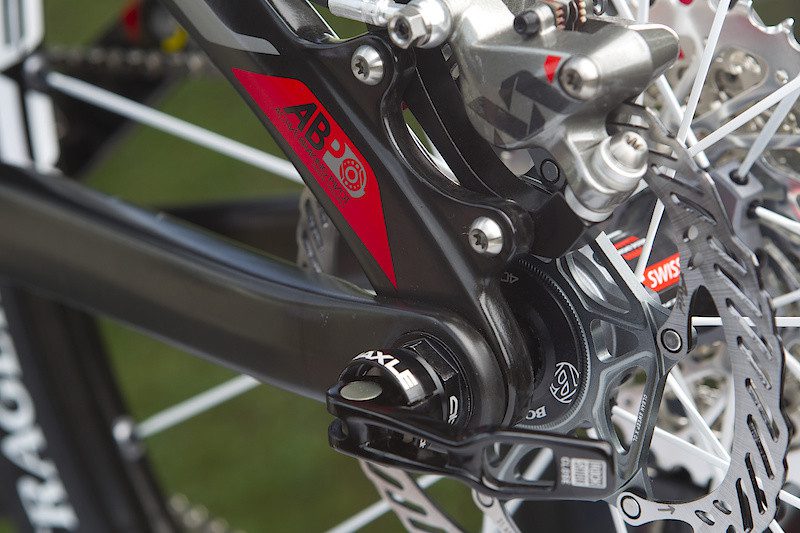
Disc brakes:  do ya need ’em?  No, you don’t.  Are they nice?  Oh yes, they are.  How nice?  It depends on the brakes, where you ride, and what kind of riding you do.  Here are the pros and cons to having decent disc brakes.  Pros–both the brake pad and the rotor are smaller, more compact, and less exposed to the elements (no more squeezing the brakes on a muddy downhill ride to have pretty much nothing happen); the brake pads tend to last longer than conventional caliper brakes; and on a long and/or steep descent, you don’t need to cramp your hands by squeezing hard (this last one is particularly true for hydraulic disc brakes).  Cons–to have disc brakes you really need to have a bike frame that is built for mounting them on; if you’re a stickler on weight, they tend to be heavier; maintaining them is a little more involved; and of course they’re more expensive.

Disc brakes are very nice (not exactly a must, but close) for mountain bikers, riders in the Pacific NW, or anyone that encounters water/mud with any frequency.  Pavement riders who basically stick to dry weather and fairly flat roads probably aren’t going to notice much if any difference.

Wheels:  for road bikes, 700c (meaning 700 mm diameter; the “c” is a long story) is pretty much the standard size.  For mountain bikes 26-inch diameter wheels are standard.  But in recent years mountain bikes with 29-inch wheels (called 29ers) have become popular.  So have 27.5-inch wheels.  Both of these come in a variety of thicknesses…the ones that mount the thickest (widest) tires require disc brakes, a special frame, and are commonly called “fat bikes”.  For road bikes, the 650b wheel size (650 mm diameter, which turns out to be the same as 27.5″) with thicker tires has become popular.  As you might guess, these non-standard wheel sizes are more expensive than the standard, although they have become more affordable as supply and selection have increased in the last few years.  These have their advantages, which include (among other things) increased comfort on the ride, ability to simply roll over some obstacles rather than swerve or hop them, and lower tire air pressure which (in theory) means fewer flats.

Gears:  For decades the standard for people who wanted a nice gear range was two or three chain rings up front, and 8 to 11 cogs on the back wheel.  Now there are a variety of choices including 1 x 11 gearing (one chain ring and 11 cogs in a wide spectrum of sizes), and internal hubs where all the gears are inside the back hub and you never see them.  Internal hubs, although they can work with a chain drive, are often used in conjunction with a carbon belt drive rather than a chain.  Carbon belts can have their problems but they never need any grease…no more chain grease stains on your pants, socks, or (God forbid) legs.  Many chain purists are proud of their “chain ring tattoos” on their calves and wouldn’t be caught dead on a carbon belt bike, but I own one such bike and I really like it for my commute and shorter rides.

Just like anything else, there is a price to be paid for anything that is relatively non-standard…the price is often increased maintenance, in addition to higher up-front cost.  For people just starting out, my advice is to start with something standard and relatively inexpensive.  As you get more into (if you get more into) biking, you can always upgrade to non-standard equipment…you will almost certainly upgrade anyway.  By then, you’ll have a better idea of what specific riding you’re into, and what you are looking for in your next bike.  And if you decide to not bike or to just remain a casual rider, you haven’t needlessly dropped a bunch of money on things that don’t really make a difference to you.

Finally, the age-old debate:  are things like kickstands, cup holders, and handlebar streamers acceptable for “serious” cyclists?  First, if you have ever referred to yourself as a “serious” cyclist, unless you are a professional chances are I don’t want to know you.  I don’t want to be serious about anything except my job, which cycling is most definitely not.  Second, cycling should be fun; why else would you do it?  And if any kind of accessory increases the fun that you’ll have, then why not put it on your bike?  I personally don’t like kickstands and have removed them from my few bikes that came with them attached, but if you think it’s worthwhile to have one, then who am I to judge?  Same goes for everything else.  Make your bike truly yours, maximize your enjoyment, and don’t worry about what anyone thinks about it.  Have fun!


Fancy Stuff–Worth the Dough?

Short answer: No. There you go!!!

However, if you’d like more details, as well as some exceptions to my short answer, read on. First I’m going to introduce yet more bike-jock (or is it bike-nerd? and is there a difference?) terminology:

Quick Release (QR) versus Thru Axle (TA): Before the middle of the 20th century, all bikes had wheel axles that were bolted onto the frame…the wheels could be removed, but only with the use of wrenches (this is still the case for a lot of kids’ and cheaper bikes, of course). If you ever got a flat tire, which happens A LOT if you bike any kind of mileage, changing the tube/tire was time consuming…and if you were out on a lonely road without the right wrenches in your immediate possession, a long hike was your destiny. Then, Tullio Campagnolo (whose last name you will hear a lot if you get into road biking, usually shortened to “Campy”, at least in the U.S.) invented the Quick Release hub.  This allowed wheels to be changed out quickly via “dropouts” on the frame (see my post “How to Talk Like a Not-Newbie”), and with just the rider’s bare hands. This revolutionary invention by Mr. Campy is still pretty much the norm on bikes of almost all kinds. Sometimes the QR has a “skewer”, which is just a thin axle bar going through the hub (and which I always assumed was the same as a Thru Axle…nope!), and sometimes it is skewerless. The basic function remains the same, though: keeping your wheels attached to the frame firmly, yet making it easy to take them off rapidly.

Fast forward to the turn of the next century (2000) with the advent of disc brakes and suspension forks especially in mountain biking (see my above-mentioned post). QR was still the standard. Hardcore mountain bikers doing a lot of jumps and rough drops were experiencing their front wheels coming partway or all the way off. This would not have been a problem, except for the fact that the bikers were still attempting to successfully continue the bike ride, and usually at high speeds on rough trail at that. Ouch! For a few reasons that I won’t go into here, QR doesn’t do as well when biking downhill over uneven trails (or jumps) when disc brakes and suspension forks are involved. So, mountain bike makers developed Thru Axles, which are like a very thick QR skewer (thicker than a wooden pencil), but the big difference is they actually thread to the “dropouts” in the frame (which are not actually “dropouts” anymore but little holes to which the wheels attach…a better term would be “wheel holes”). Because the TA threads directly to the frame, (1) the axle is a lot more solid and can resist more pressure, and (2) even if the little flip-lever on the hub comes open during a ride, the wheel will still stay on the frame (it’s a good idea to close it as soon as you safely can, though). Mountain bikers loved this, and the TA became extremely popular. Now, since road bikes are starting to become like mountain bikes in some ways (with disc brakes and taller/wider/fancier wheels), the TA is being used on more and more road bikes.

All this leads to the title question…do you really need a Thru Axle setup on your bike? If you happen to do a lot of rough mountain biking at high speed and have more than a little money (in which case you would not be reading my blog except to poke fun at it), I would say sure, get TA hubs. If you fit any other description, I would say no, you don’t need it…TA hubs are more expensive and not necessary for almost all riders. A Quick Release hub, if properly used, will hold up under all but the most extreme forces on a bike, which nobody but the most extreme riders experience. And I say this even though, at age 18, I had a QR fail on me while riding fast on my dad’s mountain bike (yes, they had mountain bikes back then…I will admit they were new to the consumer market). The front wheel came completely off and I buried the forks into a gravel road. My ensuing wreck caused me to require reconstructive surgery on the upper-left quadrant of my face. But it wasn’t the QR’s fault, it was my fault for not properly closing the QR lever. I have kept using QR hubs ever since, without any further issues. And my face is doing quite well now, thank you.

This post took up more space than I expected, so I’ll address other fancy stuff next time.  Disc brakes, suspensions front and rear, big ol’ wheels, crazy gears, kickstands, and cup holders!

How to Talk Like a Not-Newbie

I actually haven’t cared much about what people thought of me based on the terminology I used, and this was never so true as when I started biking. I didn’t want to become one of those spandex-wearing, car-hating bike jocks, so it really wasn’t a priority for me to talk like them. With the benefit of hindsight, though, I now realize I would have been able to get my ideas across (and more importantly understood the ideas conveyed to me) better, had I known some of the terminology universal to bicycles. Most of these terms (unless noted otherwise) are more or less international and apply to all kinds of bikes, which is helpful if you’re riding in another country or region. There are tons of good bike diagrams online, and I encourage you to use those, but if you like words or are just lazy, I’ve got a partial glossary for you below. These terms are in no particular order, and I will most likely have additional posts with more terminology.

Saddle: if not sounding like a newbie is important to you, get the word “seat” out of your vocabulary (the ironic exceptions are other parts of a bike such as seatstays, seat rails and the seatpost). A saddle is what bike people call a seat.

Chain ring: this is what bike people call the big gear/gears turned directly by pedals and cranks. Bike people avoid the terms “gear” or “sprocket”, unless talking about all gears generally, since these are technically not specific to any one part of the bike.

Cogs / cassette / grupo: the gears on the back wheel are called cogs. A group of cogs together is called a cassette, or if you want to show off with some Italian, a grupo. Which, if I’m not mistaken, is Italian for “group”. Pretty fancy!

Bottom bracket or BB: the bottom-most part of the frame, this is the center of the circle that the pedals orbit around. The BB houses a bunch of ball bearings and stuff that has to be replaced from time to time…depending on the bike a replacement B.B. can be super cheap or hella expensive. (It’s been cheap on all the bikes I’ve had.)

Seat rails: these are on the underside of the saddle, and they keep the saddle in place via little clamps on the top of the seatpost…but remember, it’s a saddle not a seat!

Dropouts: no, these are not hardcore bikers that left high school. Rather, they are the part of the frame that your quick-release wheel hubs attach to. If the bike is right side up on a shop stand, when loosened the wheel will just drop out of this part. Hence the name. Clever!

Seatstays and chainstays: these are the two pairs of tubes on the frame that attach to the rear wheel. The top pair are the seatstays and the bottom pair are the chainstays. Which makes sense, sort of.

Top tube: the horizontal (some times diagonal) frame bar that you straddle when you stand flat-footed astride your bike.

Down tube: the diagonal bar directly below the top tube. Makes sense.

Seat tube: the frame bar that starts at the BB and goes upward to the seatpost, which attaches to the seat rails, which are attached to the SADDLE, NOT THE SEAT!

Head tube: the front-most part of the frame, to which the forks attach. Many bikes will have a logo called a badge emblazoned on the head tube.

Bars: handlebars, or where you go with your pals after a long ride. Drop bars are the curly bars you see on road bikes or some gravel bikes.

Stem: the more-or-less horizontal piece that connects the handlebars to the frame. The short vertical piece at the other end of the stem is called the headset. Most road bikes today have an integrated headset, which means the brake levers also function as gear-shift levers (by pushing them sideways instead of pulling straight).

Brake hoods (or just Hoods): the rubbery nubs above the brake levers on a bike with drop bars. A lot of road bikers ride with their hands resting on the hoods instead of gripping the drop bars.

Crankset: the entire assembly (usually 4- or 5-pointed) that connects the pedals and the outer chain ring. The part I usually call the crank is actually the “crank arm”.

Caliper brake versus disc brake: caliper brakes are the classic version, with rubbery brake shoes clamping on the wheel rims to slow you down. Disc brakes are not new to mountain biking; they consist of a metal disc on each wheel that runs in between clamps mounted on the frame. I’m seeing disc brakes on more and more road bikes lately, hinting at their growing popularity.

Next post: Disc Brakes? Fancy drive train? Through-hubs? Kickstand? Which of these (if any) should you demand in a bike?

Finding a Bike, Part 2

So you know what your frame size is, what general type of bike you want, and how much you are willing to spend. Now you have some choices to make: where/how to buy the bike, what to look for in terms of frame material and components, and what your “hard line” criteria will be versus features that don’t matter a whole lot to you.

First, where to shop. Your general choices are a bike shop, a sporting goods store, general buy/sell sites like Craigslist, and bike-specific sites like Perfecto or Bike Exchange. You could also shop discount stores (Walmart e.g.), but I’d strongly recommend against it, so let us never speak of it again. OK. Here are the pros and cons of each, as I know them:

– Bike shop. Pros: you know what you’re buying, it’s brand new and usually covered by warranty, the salesperson (usually) knows a lot about bikes, the bikes are (usually) all of decent quality. Cons: expensive, expensive, and expensive! The markup on new bikes and accessories at a bicycle shop is like 300-800%. Don’t get me wrong; most of them need to mark prices up just to keep their doors open, and I’m proud to support my local shop by buying spare tire tubes, lights, accessories, and yes sometimes a bike there. But please know that there are options out there that are SO much cheaper, if that’s important to you.

– Sporting goods store. Pros: same as a bike shop, except that the staff usually know nothing or next to nothing about bikes, although they’ll act like they know plenty. Also, the quality on average is not good, although I’ve been pleasantly surprised once or twice by the bikes that a sporting goods store had in stock. Cons: expensive, though not as much so as a bicycle shop. But still expensive. You can occasionally find good deals on OK bikes on sale, especially toward fall (or spring for the previous year’s models). Only shop at sporting goods stores if it’s absolutely imperative that you buy a new (not used) bike, and you’re on a tight budget (like less than $600), is my advice. Even then you’ll need to shop the sales, but you may find something.

– Online marketplace like Craigslist or Ebay. Pros: can be quite cheap, and people sell some quality used bikes for less (need the cash, don’t know the value of what they have, or just trying to build up some good karma). Cons: good chance that what you’re buying is stolen (if you care…if not, well alright then). Also, there are a lot of creeps, low lifes, and overall bad people running around selling stuff online…but hopefully you knew that already and take appropriate precautions.

– Online bike classifieds like Perfecto or Bike Exchange. Pros: what you’re buying probably isn’t stolen, cheaper than buying new, on Perfecto you can look at the seller’s Strava profile (if they’re on Strava and have their account linked) and see whether they are an actual cyclist. Cons: more expensive than buying from Craigslist, and I have no experience with these sites so I can’t vouch for how awesome they are. But it’s worth at least looking into.

Now, the topic of frame materials. Unless you’re buying an inexpensive cruiser (which is probably a steel alloy frame) or an inexpensive any-other-kind (which is probably an aluminum alloy frame), there are a few materials bikes are made out of, with the pros and cons of each as I know them below:

Titanium: once only found on $7,000+ bikes, and still typically on expensive bikes only, titanium frames are increasingly found on cheaper and cheaper bikes, especially used ones. A search on Bike Exchange showed me a couple that were $2000-3000. Having never ridden titanium, I can’t judge what it’s like, but I keep reading that it combines the light weight of carbon with the bump-smoothing comfort of steel.

Carbon fiber: like titanium, this material was once rare and reserved for the spendiest of bikes, but it’s gotten cheaper to the point where I’ve bought excellent carbon road bikes for $600-900. Pros: it’s light and very stiff, making it perfect for climbing up hills quickly. Also it’s more comfortable than the lighter aluminum frames (note: most aluminum-frame bikes today have carbon forks…use caution when buying an all-aluminum bike!). Cons: can be expensive, not as comfortable as steel on long rides, and I’ve heard it breaks when hit very hard, although I’ve never witnessed that (and if you experience that kind of impact while riding, your frame is probably the least of your problems anyway).

Aluminum: before the Carbon Age began, aluminum was pretty much it for lightweight frame material. The pro racers of the 1970s and early 80s rode on aluminum. Now it can be found on department store-brand bikes that run as little as $350 new. In my opinion there are still plenty of good aluminum bikes to be found out there…it’s largely a matter of personal taste and preference. Pros: light, cheaper than most, stiff for climbing (but not as much so as carbon). Cons: not the most comfortable, kind of like carbon, but unlike carbon aluminum can seem to actually amplify the tiny little bumps in the asphalt, to where the “road buzz” makes your arms and hands tingle, which isn’t pleasant. But again, that doesn’t hold true for every aluminum bike…most of the road bikes I’ve seen lately have forks made out of carbon that dampen the road buzz to some degree.

Steel: good old steel, once the only material, then much maligned by people like me as too heavy, is making a comeback. New technology is producing lighter and lighter strong steel alloys all the time. Also, people like me are realizing that a lighter bike isn’t necessarily a better bike…being able to move and walk around after a century (100-mile ride) is pretty dang important, and on a good steel bike you can do that without sacrificing much in added weight. Nothing (except for titanium, which I haven’t ridden) is as comfortable as steel…it takes the buzz out of the road and flexes when it needs to. It isn’t as stiff as, say, carbon when climbing a hill, but just as they are making lighter steel all the time they are making stiffer (but not brittle) steel too. Pros: everything I just said. Cons: can be heavy, or can be light but expensive. I am a big fan of steel now and use it almost exclusively when training.

Next post: How to Talk Like You Know Something About Bikes.